Wow things are moving fast! Here it is the middle of February and we are already planing into the end of the summer.
Now that my mom is back, she's moved here with all her stuff now, and the kids are settled in school and both are skiing, and we are mostly moved in, and Christmas is behind us, its time to realize that I've got all my ducks in a row, and its time to implement the reason we came down here.
I've been doing what I can to get to as much training as I can, from MA to on snow to technical concepts in conversations and books, but its time to stop filling in the cracks and build a program.
A good friend of mine asked me if my Fairy Godmother came down and gave me everything I needed to have as high a chance as possible of making the team, would I still write my blog? The answer, of course, was yes. Because I don't write my blog to get stuff, I write my blog to connect with people who are living the same dream, who are human just like me, who love to ski and want to make better and better choices, to grow and become who they can be while they help other people become as well.
But his question got me thinking. If I could build myself a program that had everything I could need, like I had at the Olympic Training Center, what would it consist of? Lets pretend that there are no time constraints and no financial issues. purely in pursuit of getting my body as strong, fit, balanced, responsive, flexible and whole as it could be.
I would go to yoga four times a week. I would train with the sports Physiologist who used to train the US Ski Team who runs the performance center at the Aspen Club four times a week at least. I would alternate swimming with skinning up Aspen Mountain. I would see a nutritionist, a massage therapist, and acupuncturist, and a chiropractor, as well as a performance therapist.
I would attend MA and early morning training, I would get new snow pants and new boots. I would replace my down layer.
I would increase my core strenth CONSIDERABLY and work on balance like crazy. I would watch old ski films, re-read all my ski books, and keep growing my library of both. I'd hike the bowl and do all the training I'm already doing, and get out there and play with my mentors on the snow.
There's more, but this is where I would start. I think what I'm going to do now, is prioritize these things, for instance, I need to increase my core strength, but I can do that at home with my skier's edge machine and some sit ups. Since I'm not at the Aspen Club right now, I can't work out there (I took myself off the schedule so that I could spend more time with my kids).
Anyhow, stay tuned, because I'm going to post my training schedule and some thoughts on how to build from here to tryouts rather than waxing and waning on my way there.
The next piece I need to look at is summer training. I have Academy, a Rossignol Race Camp and a trip to Portillo Chile in the works, as well as the possibilty of going to a NASTC camp and a trip to Alaska for some steep Heli Skiing and an article. These things all take a huge amount of financial commitment, so again, that's the wish list, prioretize and see what gets done. I can write some articles for some of these things, so they may be easier to do. We'll see. I do know that I have 808 days to get my feet there, and while my skiing is changing every day for the good, I have a LONG way to go and a LOT of work to do.
Lastly, I plan to take a course in organization so that I can handle all the pieces of this rapidly evolving career and still take great care of my family as well as my clients.
I'm enjoying the process of focusing down, I hope as I focus down that everything runs more and more smoothly. It seems to be trending in that direction. Keep your fingers crossed!

Showing posts with label Training Tips. Show all posts
Showing posts with label Training Tips. Show all posts
Saturday, February 13, 2010


Monday, August 3, 2009
Welcome to Ski Season!

Okay, all yall, the lazy season is OFFICIALLY over. Sorry to burst your bubble. But its time to get fit. We have four months to get ripped, lean, strong and hydrated.
My plan, right now, is this: because I am short on time and I need to build muscle and long burning lactate threshold endurance, I'm designing a new program.
Hula Hooping! Thats right. I have my friend Leah's Gaiam Hula Hoop, and its awesome, fun, easy, and a great core and balance work out! (about 3x a day for about 15 min)
360 Balance Board, the most awesome balance and core workout, about 4x a day for about 10 min.
Skier's Edge: a total of about 20 min a day in 3-5 min incraments, working on power right now.
Low burn cardio every day, so a walk around the circle (about 3 miles), at a minimum, I do this while the kids are in the bath and Tom is watching them.
If I can get a good steep hike in, I'll take the walk around the circle and something else out.
I do sit ups, push ups, dips, and pull ups on the hang board every night, and I do dishes and laundry and anything else, including standing in the line at the grocery store, standing on one foot.
While its not ideal, its all stuff I can do at home and in spurts during the day, and its a good way to get started!
What's the time? Its time to get STRONG!!!
PS, I'm skiing the Great One off Sac on Thursday for the VIO POV ad, I'm their ski model! Yipes! Hope there's snow!
Saturday, July 11, 2009
Fit FAST and PAINFUL
Kurt sent me this from the NY times, and I'm gonna give it a try, because my time is SO limited right now, but I'm not willing to sacrifice anything, I need to get it all done AND stay fit.
Does that sound like balance to you? Hmmm... Well, its an experiment, lets try it!
June 24, 2009, 12:26 pm
Can You Get Fit in Six Minutes a Week?
By Gretchen Reynolds
Phys Ed
Getty Images
 A few years ago, researchers at the National Institute of Health and Nutrition in Japan put rats through a series of swim tests with surprising results. They had one group of rodents paddle in a small pool for six hours, this long workout broken into two sessions of three hours each. A second group of rats were made to stroke furiously through short, intense bouts of swimming, while carrying ballast to increase their workload. After 20 seconds, the weighted rats were scooped out of the water and allowed to rest for 10 seconds, before being placed back in the pool for another 20 seconds of exertion. The scientists had the rats repeat these brief, strenuous swims 14 times, for a total of about four-and-a-half minutes of swimming. Afterward, the researchers tested each rat’s muscle fibers and found that, as expected, the rats that had gone for the six-hour swim showed preliminary molecular changes that would increase endurance. But the second rodent group, which exercised for less than five minutes also showed the same molecular changes.
The potency of interval training is nothing new. Many athletes have been straining through interval sessions once or twice a week along with their regular workout for years. But what researchers have been looking at recently is whether humans, like that second group of rats, can increase endurance with only a few minutes of strenuous exercise, instead of hours? Could it be that most of us are spending more time than we need to trying to get fit?
The answer, a growing number of these sports scientists believe, may be yes.
“There was a time when the scientific literature suggested that the only way to achieve endurance was through endurance-type activities,” such as long runs or bike rides or, perhaps, six-hour swims, says Martin Gibala, PhD, chairman of the Department of Kinesiology at McMaster University in Ontario, Canada. But ongoing research from Gibala’s lab is turning that idea on its head. In one of the group’s recent studies, Gibala and his colleagues had a group of college students, who were healthy but not athletes, ride a stationary bike at a sustainable pace for between 90 and 120 minutes. Another set of students grunted through a series of short, strenuous intervals: 20 to 30 seconds of cycling at the highest intensity the riders could stand. After resting for four minutes, the students pedaled hard again for another 20 to 30 seconds, repeating the cycle four to six times (depending on how much each person could stand), “for a total of two to three minutes of very intense exercise per training session,” Gibala says.
Related
* More from Gretchen Reynolds
* Faster, Higher, Stronger
* Fitness and Nutrition News
Each of the two groups exercised three times a week. After two weeks, both groups showed almost identical increases in their endurance (as measured in a stationary bicycle time trial), even though the one group had exercised for six to nine minutes per week, and the other about five hours. Additionally, molecular changes that signal increased fitness were evident equally in both groups. “The number and size of the mitochondria within the muscles” of the students had increased significantly, Gibala says, a change that, before this work, had been associated almost exclusively with prolonged endurance training. Since mitochondria enable muscle cells to use oxygen to create energy, “changes in the volume of the mitochondria can have a big impact on endurance performance.” In other words, six minutes or so a week of hard exercise (plus the time spent warming up, cooling down, and resting between the bouts of intense work) had proven to be as good as multiple hours of working out for achieving fitness. The short, intense workouts aided in weight loss, too, although Gibala hadn’t been studying that effect. “The rate of energy expenditure remains higher longer into recovery” after brief, high-intensity exercise than after longer, easier workouts, Gibala says. Other researchers have found that similar, intense, brief sessions of exercise improve cardiac health, even among people with heart disease.
There’s a catch, though. Those six minutes, if they’re to be effective, must hurt. “We describe it as an ‘all-out’ effort,” Gibala says. You’ll be straying “well out of your comfort zone.” That level of discomfort makes some activities better-suited to intense training than others. “We haven’t studied runners,” Gibala says. The pounding involved in repeated sprinting could lead to injuries, depending on a runner’s experience and stride mechanics. But cycling and swimming work well. “I’m a terrible swimmer,” Gibala says, “so every session for me is intense, just because my technique is so awful.”
Meanwhile, his lab is studying whether people could telescope their workouts into even less time. Could a single, two- to three-minute bout of intense exercise confer the same endurance and health benefits as those six minutes of multiple intervals? Gibala is hopeful. “I’m 41, with two young children,” he says. “I don’t have time to go out and exercise for hours.” The results should be available this fall.
The Phys Ed column will appear here in Well every Wednesday and also in print once a month, in the Sunday magazine. In it, Gretchen Reynolds, who is working on a book about the frontiers of fitness, will write about what the latest science can tell us about how to make ourselves stronger, more flexible, less prone to pain and generally fitter and healthier. We want to hear what you think, so stay tuned and offer your comments and questions.
Does that sound like balance to you? Hmmm... Well, its an experiment, lets try it!
June 24, 2009, 12:26 pm
Can You Get Fit in Six Minutes a Week?
By Gretchen Reynolds
Phys Ed
Getty Images
A few years ago, researchers at the National Institute of Health and Nutrition in Japan put rats through a series of swim tests with surprising results. They had one group of rodents paddle in a small pool for six hours, this long workout broken into two sessions of three hours each. A second group of rats were made to stroke furiously through short, intense bouts of swimming, while carrying ballast to increase their workload. After 20 seconds, the weighted rats were scooped out of the water and allowed to rest for 10 seconds, before being placed back in the pool for another 20 seconds of exertion. The scientists had the rats repeat these brief, strenuous swims 14 times, for a total of about four-and-a-half minutes of swimming. Afterward, the researchers tested each rat’s muscle fibers and found that, as expected, the rats that had gone for the six-hour swim showed preliminary molecular changes that would increase endurance. But the second rodent group, which exercised for less than five minutes also showed the same molecular changes.The potency of interval training is nothing new. Many athletes have been straining through interval sessions once or twice a week along with their regular workout for years. But what researchers have been looking at recently is whether humans, like that second group of rats, can increase endurance with only a few minutes of strenuous exercise, instead of hours? Could it be that most of us are spending more time than we need to trying to get fit?
The answer, a growing number of these sports scientists believe, may be yes.
“There was a time when the scientific literature suggested that the only way to achieve endurance was through endurance-type activities,” such as long runs or bike rides or, perhaps, six-hour swims, says Martin Gibala, PhD, chairman of the Department of Kinesiology at McMaster University in Ontario, Canada. But ongoing research from Gibala’s lab is turning that idea on its head. In one of the group’s recent studies, Gibala and his colleagues had a group of college students, who were healthy but not athletes, ride a stationary bike at a sustainable pace for between 90 and 120 minutes. Another set of students grunted through a series of short, strenuous intervals: 20 to 30 seconds of cycling at the highest intensity the riders could stand. After resting for four minutes, the students pedaled hard again for another 20 to 30 seconds, repeating the cycle four to six times (depending on how much each person could stand), “for a total of two to three minutes of very intense exercise per training session,” Gibala says.
Related
* More from Gretchen Reynolds
* Faster, Higher, Stronger
* Fitness and Nutrition News
Each of the two groups exercised three times a week. After two weeks, both groups showed almost identical increases in their endurance (as measured in a stationary bicycle time trial), even though the one group had exercised for six to nine minutes per week, and the other about five hours. Additionally, molecular changes that signal increased fitness were evident equally in both groups. “The number and size of the mitochondria within the muscles” of the students had increased significantly, Gibala says, a change that, before this work, had been associated almost exclusively with prolonged endurance training. Since mitochondria enable muscle cells to use oxygen to create energy, “changes in the volume of the mitochondria can have a big impact on endurance performance.” In other words, six minutes or so a week of hard exercise (plus the time spent warming up, cooling down, and resting between the bouts of intense work) had proven to be as good as multiple hours of working out for achieving fitness. The short, intense workouts aided in weight loss, too, although Gibala hadn’t been studying that effect. “The rate of energy expenditure remains higher longer into recovery” after brief, high-intensity exercise than after longer, easier workouts, Gibala says. Other researchers have found that similar, intense, brief sessions of exercise improve cardiac health, even among people with heart disease.
There’s a catch, though. Those six minutes, if they’re to be effective, must hurt. “We describe it as an ‘all-out’ effort,” Gibala says. You’ll be straying “well out of your comfort zone.” That level of discomfort makes some activities better-suited to intense training than others. “We haven’t studied runners,” Gibala says. The pounding involved in repeated sprinting could lead to injuries, depending on a runner’s experience and stride mechanics. But cycling and swimming work well. “I’m a terrible swimmer,” Gibala says, “so every session for me is intense, just because my technique is so awful.”
Meanwhile, his lab is studying whether people could telescope their workouts into even less time. Could a single, two- to three-minute bout of intense exercise confer the same endurance and health benefits as those six minutes of multiple intervals? Gibala is hopeful. “I’m 41, with two young children,” he says. “I don’t have time to go out and exercise for hours.” The results should be available this fall.
The Phys Ed column will appear here in Well every Wednesday and also in print once a month, in the Sunday magazine. In it, Gretchen Reynolds, who is working on a book about the frontiers of fitness, will write about what the latest science can tell us about how to make ourselves stronger, more flexible, less prone to pain and generally fitter and healthier. We want to hear what you think, so stay tuned and offer your comments and questions.
Monday, June 9, 2008
Hard Head Performance Coaching at its NEW DOMAIN!

ITS UP! Please visit www.hardheadcoaching.com to check out my Performance Coaching pages! For a limited time, all my coaching articles and documents are viewable by everyone, but soon those pages will be password protected for clients only.
Please view the site in SAFARI, as it is STILL loading improperly into other browsers (grrrr, working on it).
What IS Hard Head Coaching? Its my own unique method of coaching based on 18 years of coaxing elite level athletes into performance breakthroughs. My job is to help you learn to allow yourself to perform to your ABSOLUTE POTENTIAL in all situations, with a calm, clear mind.
NEW to the Hard Head program is coaching for your coaches! Do you want to add a new dimension to your training program? Book me for a Training session, and I will travel to you, and teach YOUR coaches how to recognize destructive emotional and psychological situations in YOUR athletes and diffuse them.
Friday, June 6, 2008
Quit Pokin' me in the BUTT!

I was talking with Kurt while we were out in the Beartooth wilderness about discipline in training.
He has some great theories on SUCKING IT UP, and I thought I'd share some of them with you, so that the next time you face a situation that seems hard, less than fun, and necessary to reach your goal, you can just HARDEN THE F UP and get it done.
I have decided that I need to hike something steep every day. No matter what. (YES, rest day, YES. On that day I will do something different that is also physical, but gentle... just to put this out there, its NOT good to overtrain, and I am prone to it.)
But NOT hiking because its raining, or I am in the middle of a big project, or whatever the excuse might be just isn't cutting it with the goals that I have. This is not a compromise I can make, because when I take time away from this, I loose muscle, gain fat, and loose energy. The inertia of not having done something physical sets in, and if I can skip one day, I can skip two. Then its a week, I've gained three pounds of fat, and I feel lazy, sad, and disappointed in myself.
While we were in the back country, I was working on rhythm in hiking. Setting and maintaining a pace, matching my breathing to that pace, and not stopping even when it gets hard. If it gets very hard, slowing down, breathing deep until I feel that I am recovering. And then, the pace picks up again, and the rhythm sets in again, and up we go.
I got to practice this in actuality on the bootpack, because every time I slowed down, or stopped, I got poked in the ass with Kurt's ski pole. Hiking or skinning with him, like Angela, is a bit like following the Terminator around, "Ya, I will hike you now" they never slow down, never break pace, and are unstopable. I want that. I want my body to be that strong, consistent. YES its hard. YES I can get there. But only if I am willing to push through the parts that are hard to do it.
If I want to be there, be that fit, be that strong, have that kind of unending insurance so I can go SKI the things I want to ski, that means that when it gets hard, I realize that THIS IS WHERE THE WORK GETS DONE! I used to say it all the time to my coaching clients in Climbing. It hurts? Great. NOW we are getting strong. Because in Climbing, in anything where you are up against the evils of lactate threshold endurance, functioning when it hurts and its hard is where you grow. CAN you put your head down and keep going? Of course you can.
 Yesterday, I got out of my car and I looked up at the cliffband on the steep side of the M trail, and decided that I was going to set a pace, and keep that pace, until I got to the cliff band, and manage my pain with my breathing, not stopping or slowing until I made my goal. I knew this was going to be hard, the M is very steep, much like a bootpack up a ridge line.
I started off, happy with my goal, and felt a bit giddy with the realization (the fourth or fifth time I've had this realization since the back country season started): I am so much stronger than I was at the end of the year last year! Fitness, apparently, is cumulative over the span of years, not just within week long training periods. I guess I've always known this, but I've never come back from SUCH a lack of fitness as I have in this period of my life to watch it happen.
This realization made me SO happy for my friends who are struggling to start some sort of fitness, the goal usually being to be thinner, because they are 30-80lbs over weight, and hate the way they look. And MAN, I know that place, it sucks. BUT the cool thing is that the journey is longer than that! Your body will make a new base line for fitness, and build on that, over and over again, until YOU who were 60 lbs over weight, and nearly sedentary (YES I AM talking about me LAST January!!) can look forward to a 20 mile run. I'm not kidding.
I digress.
Here I am hiking up the M. And about a third of the way up, I can feel my thighs, and I do a systems check... nothing is tired. I'm breathing heavier, my heart rate is up, and I can feel my thighs and calves, but none of it hurts. Why then, do I have the desire to pull over and stop? Why do I think to myself, oh, there is so much further to go? I wish I was done... Just rest for a sec, no one will know, slow down... like a nagging voice in my head...
And suddenly, as the voice gets louder, and I seriously consider slowing down, I feel someone poke me in the butt with their ski pole. Do you want to get stronger or not? This is when the work gets done. If you want this kind of fitness, you need to train to this kind of fitness. This is not a consolation buffet, oh, you went outside, therefor next time you climb something steep you will magically have the ability to be fast and consistent. This is a system of DIRECT work/reward. No work, no reward. And we aren't talking about LIPSERVICE, there is NO reward for that.
And I did it. And I'm stronger today. I didn't like it. It was hard, I had to check my will o meter constantly, not because I was tired, or hurt, or working too hard, but because I've given myself quarter in the past as I was training up to a level where I CAN expect more of myself. Guess what? I can expect more of myself now. Time to change expectations, ask for more, and follow through.
 I bring this up for two reasons, I think its important for training at any level, a little honest discussion and reflection that asks you to work hard, so you aren't just SAYING "I want this" but doing what you can to build fitness to GET there, but also because it relates directly to my previous post of the day about derailing the train.
Are you trapped in your office? Are you staring at a huge pile of taxes, or websites you need to build, and you'd really rather just check out and watch South Park than get it done? Guess what? This takes JUST as much practice and discipline as hiking up something steep.
Sitting there wishing it was easier isn't going to make the pitch less steep or the paperwork less pressing. Sitting there thinking of all the things you should be doing while doing none of them isn't making it easier to get to your goal. If anything, it makes it harder, because now your critic is in your head, telling you you suck.
That's like adding another mile to the boot pack. Remember, anything done reluctantly is twice as hard. Your reality is really what you make it in this case. You can look at the challenge, and ask yourself "Can I do this?" Of course you can. You can do anything you put your mind to. One foot in front of the other until you realize you are stronger than you thought you were, you are almost there, you are doing it...
And if you need it, have someone poke you in the butt with a ski pole, it helps a lot.
The Bozeman Trail Report
Do you know about this blog??? This is AWESOME!!!!
 Tuesday, June 3, 2008
Leverich is clear
Leverich is in good shape, only a small patch of snow at the top and all the rest is nice and tacky. The creek is a lot more reasonable then the ones in the Bridgers too.
Also, Muskrat creek in the Elkhorns is dry for 4 miles or so too.
Posted by john at 8:38 PM 0 comments
Sunday, June 1, 2008
Bangtail Divide
It's clear all the way through the 8 YEARS of switchbacks. After backing the switches there are only 4-5 snowy spots that require the rider to get off and trudge through 10 foot long 2 foot deep snow drifts. The snowy sections are accented by 20 feet of muddy trail prior to hitting the mounds.
When you reach the big bald hill with the two fences that's pretty much it. The north facing slope beyond that resembles a glacier right now. If the weather stays in the high 60's it might be clear in about 3 weeks (!).
It's a fun climb, but descending those damned switchbacks is FAR from ideal bombing. Go go go, brake, turn. Go go go, stop, turn. Go go go, stop, turn. Go go go, brake, turn. Go go go, brake, turn. Go go go, brake, turn. Go go go, brake, turn. Go go go, brake, turn. Go go go, brake, turn. Go go go, brake, turn.
This is where I turned around:
Posted by Denny. at 12:45 AM 0 comments
 Tuesday, June 3, 2008
Leverich is clear
Leverich is in good shape, only a small patch of snow at the top and all the rest is nice and tacky. The creek is a lot more reasonable then the ones in the Bridgers too.
Also, Muskrat creek in the Elkhorns is dry for 4 miles or so too.
Posted by john at 8:38 PM 0 comments
Sunday, June 1, 2008
Bangtail Divide
It's clear all the way through the 8 YEARS of switchbacks. After backing the switches there are only 4-5 snowy spots that require the rider to get off and trudge through 10 foot long 2 foot deep snow drifts. The snowy sections are accented by 20 feet of muddy trail prior to hitting the mounds.
When you reach the big bald hill with the two fences that's pretty much it. The north facing slope beyond that resembles a glacier right now. If the weather stays in the high 60's it might be clear in about 3 weeks (!).
It's a fun climb, but descending those damned switchbacks is FAR from ideal bombing. Go go go, brake, turn. Go go go, stop, turn. Go go go, stop, turn. Go go go, brake, turn. Go go go, brake, turn. Go go go, brake, turn. Go go go, brake, turn. Go go go, brake, turn. Go go go, brake, turn. Go go go, brake, turn.
This is where I turned around:
Posted by Denny. at 12:45 AM 0 comments
Wednesday, April 16, 2008
Right back AT YA!

The week in Aspen was, of course, amazing. Here is one little gem that I wanted to share with you: I had the undeniable privilege of working with Kurt Fehrenbach for two and a half days while I was in Aspen. He came to my performance talk, and then... he used it on me while working with me! YES! HOW COOL IS THAT? I got to coach myself through the eyes of an amazing coach (if that makes sense.) Sometimes I have a hard time taking my wins when I get rocked hard, and Kurt made me ski this little transition over and over again that just scared the piss out of me. And every time, he skied by me and said "That's a win! It was better this time!" And, of course, I immediately felt a huge boost, I felt proud and happy for how well I had done, rather than belaboring the fact that I want to do it perfectly. A great GREAT reminder of how positivity works to build positive results. Thanks, Kurt!
Wednesday, March 19, 2008
My first contribution to ABCs of skiing: Why do my thighs burn when I ski?

Visit here to see the answer on ABCs of skiing, or read below, and let me know what you think!
The short and most probable answer is that you are "in the back seat". Its possible to be in the back seat even when you are pushing as hard as you can on the cuffs of your boots. If you break at the waist and stick your bottom out, or bend at the knees to drop your seat lower, like sitting in a chair, you are engaging your quads.
Try this exercise. Stand in your boots. Stand up just as tall as you can. Now, drop your heels down into your boots. Then, relax your shins against the fronts of your boots, naturally. Now, tuck your tailbone under just a titch to take any sway out of your back. Now, pretend like someone just punched you in your stomach, allowing your spine to curve just a bit. Elbows go in front of torso, hands outside of elbows.
WHEW! You should be in a good dynamic, strong posture now. You should have an angle of about 15 degrees in your lower leg, and it should match the angle of your back from the hips up. Your bottom should be right over your feet, and you should feel even pressure all along the bottoms of your feet.
If you feel your thighs, try thinking of your femur as a line. If, looking down, the line of your femur is pointing from hip, to knee, to any place in FRONT of your toe piece of your binding, your thighs are probably engaged, and you are probably slightly back. Try pointing the line that your femur makes from your hip to your knee and then right AT your toe piece of your binding. Now your flex and athletic stance are coming from the ankle and knee, rather than your waist and hip.
Remember that forces are generated in each turn, and that you are constantly striving to get back into balance over your feet, right over your skis. Muscularly resist the urge to get dumped in the back seat at the end of each turn, and you will find yourself with less work to get back in the middle, neutral, ready position.
Let me know if this helps, and feel free to visit http://www.skiingintheshower.blogspot.com for more info!
Thursday, March 13, 2008
She Can be Taught! Learning to suck less in the bumps at Snowbird
I want to write a longer post about both of these things, the carve and the bumps, but Its 2am and we have an early morning clinic! So here is a quick summary which I will expand on later:
I pop in the bumps. My hands fly up, my steering move is too quick, single footed, and I am not moving in the direction of my new turn. Hence, I am constantly getting compressed and flying over the handlebars.
Rob gave me a great progression to fix this:
Whitepass turns on the groomer.
Whitepass turns in the bumps.
Allow the compression/absorption phase to be what draws your old downhill ski onto its outside edge.
Phase out the whitepass.
As your absorption phase happens, allow your body to cross your skis over the bump, pulling you onto your new outside edge of the new inside ski. This takes trust and commitment, but is super key to making the move less abrupt.
Use your pole plant to stop your rotation like you would in a short swing.
In this video, I think you can see the top two turns are my old style turns, and I kind of go down the progression, until the last six turns or so are smoother, and I have probably the best ski to snow contact yet! I'll post a bump video from the day before as soon as I get a chance, so you can see it before the 20 minute progression that we did. TOO FUN!!
Friday, February 22, 2008
Move along the length of the ski!
Shannon and I spent a powder day geeking out on a new movement pattern on the groomers at Aspen Mountain.
This is a rough edit of the thought process we went through on that day. Now that we've spent a week skiing it and talking about it, I think I can explain it in a much more succinct way, but I am very eager to get this up and hear your comments and ideas.
I'll shoot a new, shorter version as soon as I get a chance. Thanks for watching!
This is a rough edit of the thought process we went through on that day. Now that we've spent a week skiing it and talking about it, I think I can explain it in a much more succinct way, but I am very eager to get this up and hear your comments and ideas.
I'll shoot a new, shorter version as soon as I get a chance. Thanks for watching!
Saturday, September 15, 2007
Dopamine RULES!
This is a great comment on the Failure as a Diagnostic Tool post, from Lisa, and it was so interesting, I thought it warranted its own post:
From Lisa:
You could relate this to the neurobiology underlying motivation. Reward feelings relate to pulses of dopamine in the brain. Anything can elicit a pulse- a success in sports, a positive social interaction, viewing art, etc. We then feel motivated to further pursue these sources of dopamine. There are two kickers though (aside from issues of addiction which I won't go into). The first is that, as Peter Sterling writes, "satisfaction cannot be stored". Dopamine pulses are transitory events. We need constant stimulation to stay satisfied. Not only that, but (and this is kicker #2) dopamine is secreted only when an experience slightly exceeds expectation. This is why our past accolades don't feel so rewarding anymore. This also explains the curse of the child with super acheiver parents or the has-been celebrity.
The good news is that we can pretty easily turn our "failures" into sources of satisfaction. As in "Wow, I don't really suck quite as much as I thought at this." dopamine pulse. or "Wow I am getting better." dopamine pulse again. Pretty much exactly as you describe learning to ski on ice.
This is how I learned statistics.
From Lisa:
You could relate this to the neurobiology underlying motivation. Reward feelings relate to pulses of dopamine in the brain. Anything can elicit a pulse- a success in sports, a positive social interaction, viewing art, etc. We then feel motivated to further pursue these sources of dopamine. There are two kickers though (aside from issues of addiction which I won't go into). The first is that, as Peter Sterling writes, "satisfaction cannot be stored". Dopamine pulses are transitory events. We need constant stimulation to stay satisfied. Not only that, but (and this is kicker #2) dopamine is secreted only when an experience slightly exceeds expectation. This is why our past accolades don't feel so rewarding anymore. This also explains the curse of the child with super acheiver parents or the has-been celebrity.
The good news is that we can pretty easily turn our "failures" into sources of satisfaction. As in "Wow, I don't really suck quite as much as I thought at this." dopamine pulse. or "Wow I am getting better." dopamine pulse again. Pretty much exactly as you describe learning to ski on ice.
This is how I learned statistics.
Thursday, August 30, 2007
PSIA now on Facebook!

Facebook is a great way to stay in touch and network. Many large companies, schools and organizations use it to keep in tough, exchange ideas, get rides together to events, whatever!
PSIA wasn't on there, so I just made a group. Check it out and join!
http://www.facebook.com/group.php?gid=5425342541
Wednesday, August 22, 2007
PSIA Progression Session at Mt. Hood!
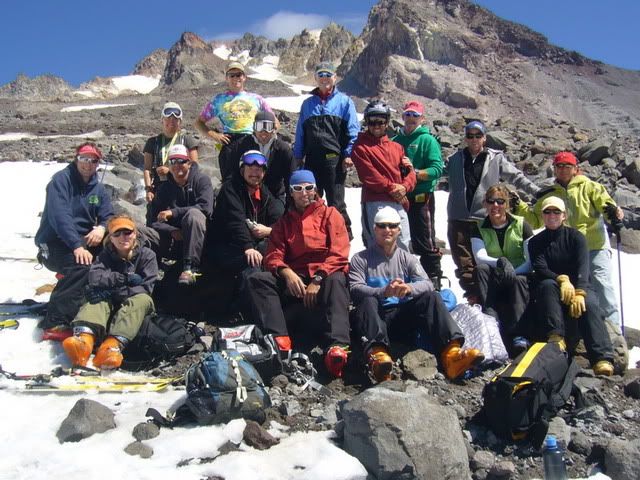
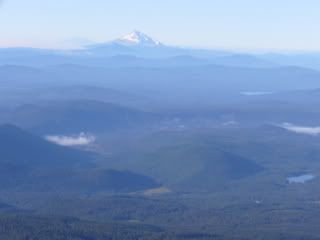
WOW, it took a long time to get to this post! Anyhoo, here we are. Back safe and sound from an amazing 3 days at Mt. Hood, Oregon, training for the D-Team tryouts with Rob Sogard, Nelson Wingard, Chris Kastner and Sean Smith.
In a (large) nutshell: here it is:
I got back from checking the lovable and slightly stressed Liat into Avalon Hills, and had two days to get my s**t together to get to the Demo Team tryout training. (Sob, sob, here's the sob story...) I was freaking out a bit, because I haven't worked out in a MONTH, as Liat and I had been on hard core crazy watch, my (new!) skis were dull, and I don't know how to tune them yet, and I hadn't packed, watched any of the film I had meant to watch, or prepared in any way for the last month or so. Oh, and I got a raging sinus infection on my way back from Salt Lake, and had a fever of 103, feeling like someone had hit me in the face with a hammer, and just wanted to sleep all day.
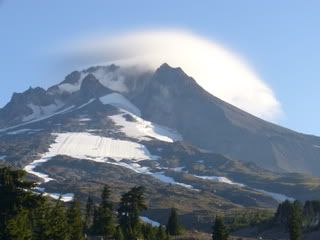
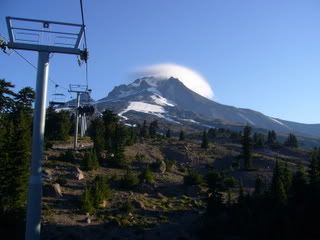
It was fine. It was actually fun. I learned a lot about Troy, for instance, that he does a mean Celine Dion impression (Allll by myself... don't wanna be... all by MYSELF! AnyMORE!!) That did it right there, I had a whole new respect for the man immediately. Unfortunately, I did NOT get it on tape, but I promise you before the end of 2007, I will have that man singing that song, and I will post it RIGHT HERE for your viewing enjoyment. Needless to say it was an easy 13 hours.
We got in at 2am to the Huckleberry Inn in Timberline at Mt. Hood, (after driving through all kinds of orchards and wineries, who knew?) and tried to check in. Unfortunately, the short order cook for the 24 hour diner was also the desk clerk, so we had to wait an additional 20 minutes for him to finish cooking dinner for his customers before he came over and couldn't find us in the reservation book. I'll skip all the nonsense that happened from here, but let me just say, it was an adventure just getting our keys (actually, he wouldn't give one to Troy, he said "just go knock").
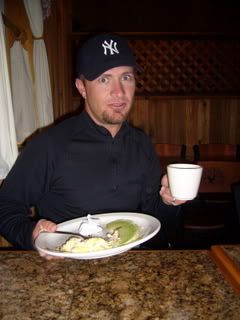
I'll skip all the hilarity that ensued trying to convince the cooks that we were with the group buffet breakfast that was supposed to be included in our room, and skip right to the mountain. We drove up, meeting at 6:30 in the morning to get our tix and see all the folks that were coming up from Portland or camping. The venerable Ben Roberts, who put this whole thing together, was handing out tix and looking all official, it was great to see him again.
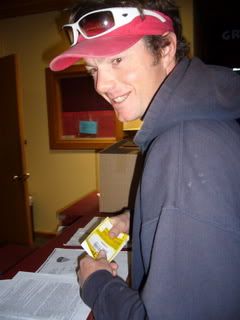
We loaded on to our next chair to get up to the top of the glacier, and figured out what Ben meant by "lanes". The glacier is groomed carefully, and each group gets a lane, like a bowling lane, about 4 cat tracks wide. We were in lane 7 on the first day, the first lane being for the general public, then there was the US Development Ski Team, the US Juniors, Lyons Race Camp and so on and so forth, and then us, PSIA in all its glory.
The first day I was really nervous. First off, I suck on Ice, and Ben had warned us to come with sharp skis. But lucky for me, some of the skiing I'd been doing, especially my last trip with Spohler to the Beartooths, paid off a bit, and I actually had some turn shape, right out of the gate.
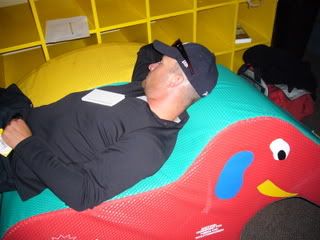
Now, for comparison, uh... Rob and Nelson and Ben just carved that stuff up like it was nothing. I think maybe Ben likes to go fast. Just a hunch. Anyhoo...
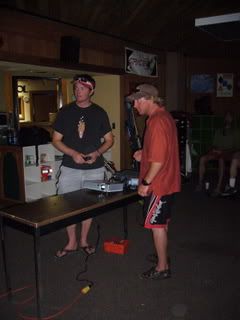
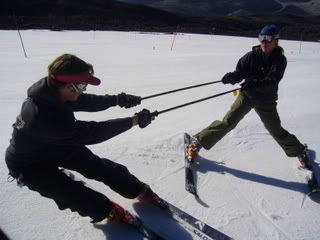
This was my job for the day. Let me first say "YAY ROB!" that was great advice. Which is not surprising, but hey, it gave me a HUGE breakthrough, which I kept secretly all inside, because, you know, its just not cool to go bouncing all around the slopes going "I get it I get it I get it!! YaY!" Alright. Day 1, purposeful platform.
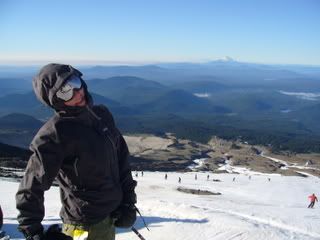
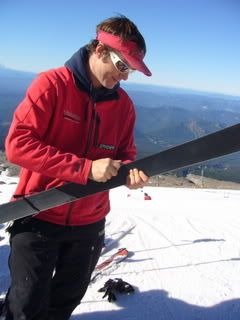
It felt just like an edge take off jump in skating, like the loop jump, you enter into it, spiraling inwards, adding force to your edges as you compress the circle, and in skating, you release into the air, on skis, you release so you can go the other way... This made me wonder if I could maybe DO a loop jump on skis... something to look at this winter maybe... how cool would that be?
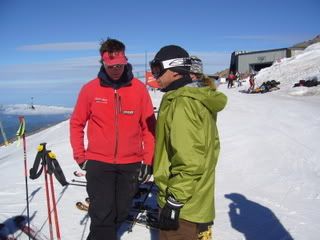
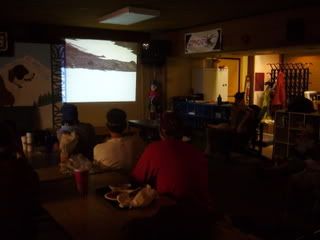
We headed back inside for video and lunch, and I had two very interesting experiences here: first, the guy that shot the video for us on this day... um... well, he didn't think that I was part of the group, so he didn't shoot very much of me. Ah. And then, what he did shoot, well, I was going so slowly, that I didn't get to see all of my turns in a run. And the capper?
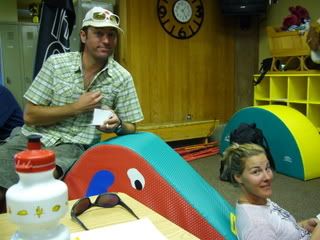
I got lots of props from the VERY Supportive group, and I sheepishly went back to my seat, determined to make a visually significant change on the next day.
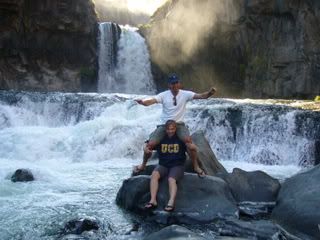

We drove through some tribal land where the native Americans fish with super long spears from wooden towers in the river, and Chris spied someone who had caught a salmon that went up to his WAIST! Very cool.
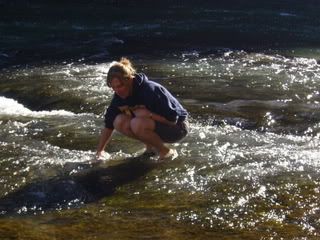
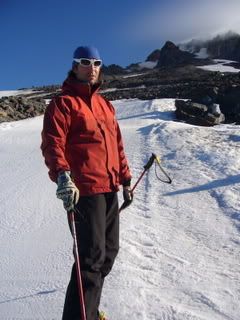
At about 12:30 we realized we'd better get our acts together and made it back to the hotel by about 1 or so... another late night, another early morning, but OOPS! Out of gas. We were about 1/2 way up the hill to the ski area when the Subaru choked, and Jill, the ever level headed, flipped us around, and we coasted in Neutral back down to the gas pump in town. No pushing, no towing, no walking. EXCELLENT!
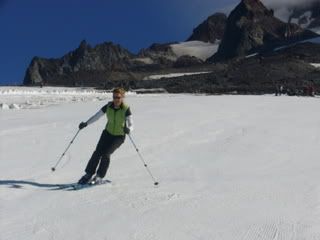
He looked surprised. "Oh, yeah. One foot out, two feet up, hands outside of elbows, elbows in front of torso."
I looked at him. "Are you serious?"
"Yup."
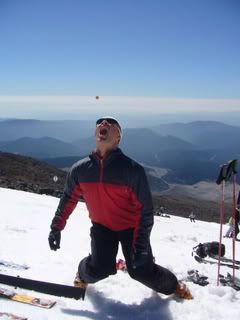
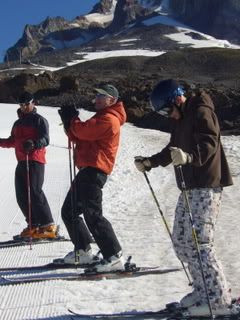
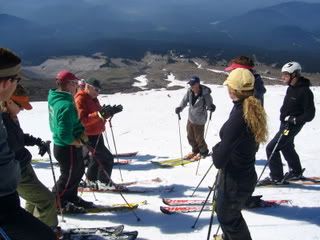
The day was spent skiing tasks and talking about what they are looking for when we ski these tasks at the try outs:
Skiing the tasks in 50/50 groomed and crud, on frozen coral reef, in big bumps, in slush, and the turn needs to be the same no matter what, the skis working effectively, no matter the terrain, the ski tips both bending and working, the ski not loosing momentum, the inside ski driving, if you air, the tip of the outside ski coming down first, continuing to drive, move and work.
Check, check, check.
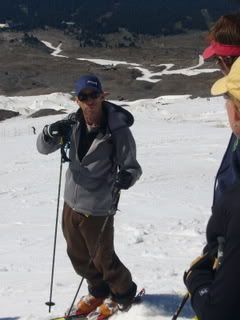
I camped out with Rob and Sean for a while and listened in on a bunch of Movement Analysis, chipping in when I could, and learned a TON about what they are looking for, what the nuances of the ski working were, and then taking it out and trying it on my own. Rob pegged me for the impatient person that I am "Right, I get it, and I want the next instruction", but said it was good that I went back and forth between laying one down and pushing my limits, and then backing off and working on my control again.

I got the topic "Discuss how lateral learning relates to building the skill set" and freaked out for a minute, but I had 5 minutes in the hall to prepare, and luckily, I got to double check what lateral learning meant as one of the guys came out to use the bathroom.
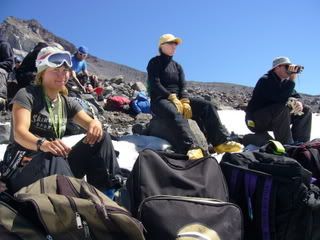
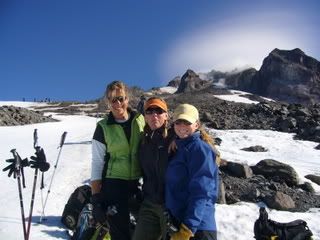
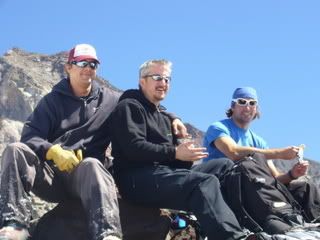
I really wasn't sure I was going to be any help on the drive, but after an Applebees feast, I perked back up, and we got to Jill's house at 4 in the morning. Night, all!
I got back to my house at about 5am, and slept until Wednesday. I've been so long posting because I was in bed for a week after that. Today, finally, I feel human. Yesterday was okay, today is great, back to the gym tomorrow!
If only it would start snowing! We had a huge thunderstorm the other day, and the weather has officially changed from 90's summertime to 60's fall weather, I've broken out the long sleeves and jeans with the hopes of egging on the winter... and I have to admit that I checked weather.com, just on the off chance that it was going to snow on August 16... patience, Kate, patience...
Sunday, August 19, 2007
Cindy Sez: A Burn Out Bummer
I got this comment a while back on the "Never let Go of Your Branch" post, and I thought it merited its own post... Thanks to everyone who has been commenting, I will catch up on my replies as quickly as I can now that I am back!
 Most of the time, burn out isn't quite this spectacular. It comes on us slowly, and suddenly one day, we realize we just don't care anymore, and don't have the will or desire to change it, or even to understand what happened. Some brief thoughts on getting it back.
Hi Kate,
I met you at Academy this year and you came to the party that I helped throw on the last night. I stumbled upon you blog and I think it is great. As I have recently lost a little spirit with skiing, it is great to hear our story.Cheers and I would love to hear more about how you over come your sabotages tendency when you get close to the top.
Thanks,
Cindy
Hey, Cindy
Thanks so much! I loved the party by the way, it was a blast. I know what you mean about loosing spirit with skiing, it happens to all of us with almost everything we do. It happened to my mom with scrap booking, it happened to me with rock climbing, and with skating, and it is one of the things that can shake you out of your tree more than anything else.
As I think about this, I think about how frustrating it is to feel this way, just, disillusioned. Lost. Just not interested. (To me anyway.) It can feel like what used to be fun is now work, and maybe the best way to gauge how psyched you are to do it is, well, are you excited to get out of bed at 5am to do it?
If you are feeling flat, probably not. There are ways to get around this, but the first thing, I think, is to check and see if its worth it to you! For my mom, while she had really enjoyed scrap booking, (it had been a bit of an obsession with her), probably not. It wasn't really worth what it would take to push through her performance plateau and make some real breakthroughs. (You'd be surprised, there's ways you can do it, even for scrap booking... you can go to Scrap booking conventions, and three day all nighters with a bunch of other scrap bookers...) But for my mom, she had to just decide, you know, I used to love this, and I have kind of turned it into a job, an obligation to the family, and its just not fun anymore. So she took a break. She isn't sure how long that break will be, but, for now, she is collecting things she may make pages on one day, and just leaving it at that.
You are in a bit of a different situation, having chosen this as a career for you. But maybe not. My mom viewed something she had loved as a job that was no longer fun, maybe the same thing is happening to you.
We didn't really get a chance to talk about skiing and how you came to it and why you teach, and where you want to go with it, so I can't ponder your dilemma directly, but I do know that almost everyone goes through this, with almost everything they do, their marriage, their job, their hobby, their sport, whatever you spend too much time doing, it will, eventually, go flat.
I faced this problem with several of the climbers that trained at a really high level when I was coaching. When you train that hard, with goals that are that difficult to attain, sometimes it just ceases to be fun. And you wonder why you are there, why you are sacrificing the things you sacrifice to work out all day every day. What can you possibly hope to gain?
This goes right back to the "Never let go of your Branch" theory. This flatness, this wondering, this plateau, in desire (and usually performance), is the A-#1 thing that shakes people out of their tree.
I think the trick, here, is to decide if the amount of sacrifice you need to make to get to a place where you love it again, or the amount of belief you have to have in yourself to love what you are doing even when you don't seem to be improving, is worth it.
And that comes down to a different question for everyone. Ben Roberts and I were having a very interesting talk at the Progression Session at Mt. Hood last week (which I will post about soon, I promise), and we were talking about people's motivations. Why you are aspiring to what you are aspiring to.
A lot of times, people don't know. A lot of the people I skated with at the National level were skating because they wanted their parents to be proud of them. They didn't even like skating any more. A lot of them were skating for the fame and the endorsements. A very very few were doing it because they just really loved skating, and they really loved the hard work it took to get to the next level.
So if I were to give you some advice here, I guess I would say, step back and examine why you are in skiing, where you want to go, and why you want to go there. Then you might have some leading questions, that might point the way to weather it's worth it to plug ahead and push yourself, or whether doing that might make something you once loved even less attractive. This is a lot of introspective work, that can be really clouded by lots of different things.
I coached a climber who had the most amazing natural talent I've ever seen at 13. By all rights, he should be on the cover of Climbing magazine monthly. He should be the best climber in the world. He can't succeed because his parenting won't allow him to. His father wants him to win so badly that the boy can't be good enough no matter what he does. When he looses, his father wonders why the boy isn't good enough, and why the boy doesn't have a real job. The boy is doomed no matter what he does, the thing he loves and is talented at is tainted because his sense of self worth is tied to his father's pride in his own success. But he can never succeed, because no matter what he does, he can't be good enough.
This is a pretty extreme example, but I think, when we are looking at ourselves, and excavating the things that are stopping us from being a success or happy at what we have chosen to do, we need to look at outside factors, things that might be installed in us from childhood, as patterns of sabotage. They can be aiding and abetting in our flatness, when things get too intense.
Another thing to think about is learning, as you get to that elite level, to take joy in the minor successes. It is so hard to be psyched and get juiced about your progress when it comes in minute doses far apart. Here you are, after 10 years of teaching, after being a clinician, still working on your turn shape. Thrilling.
But somehow, it has to be. As the learning curve slows down and the progress plateaus, and the plateaus get longer and harder to endure, looking for something to light you on fire becomes a big challenge.
For me, its drills and training. I love to train. This is a bit abnormal, I know, and it is actually rooted in some less than healthy behavior from my childhood. Now that I have worked through that stuff, though, the desire to train has a new meaning for me, and it still gives me the boost that I love. I like to challenge myself with tasks, see where I fall short, train out the weakness, and try the challenge again.
Unfortunately, I am, as Rob pointed out this past weekend, impatient. I like to tackle and conquer, moving on to the next thing. I don't have a lot of patience for endless repetition of the same drill over and over. I like to think that if I have some modicum of success, I have mastered the drill, and I can move on. This kind of cocky attitude leaves holes in my skill set that I pay for later, having to drill out bad compensating habits that I have set up for myself with my impatience.
But when I feel like my interest is waning in something whose overall goal is important to me (no, I don't WANT to practice perfect freakin' wedge turns! good LORD, I want to go SKIING!), I think about what the discipline to get through the task means to my overall ability to reach my goal, and I get a little mini thrill from the fact that I am willing to buckle down and do what needs to be done. Rather than looking at the task itself, I take pride in my ability to be willing to go harder, further, longer, and more dedicated that I thought I could.
In this way, I sort of talk myself into being excited about whatever it is I am working on. I had this same issue with school figures in skating. I sucked at them. I don't have that kind of patience, 90 minutes tracing a pattern to within a quarter of an inch on the ice. I always ALWAYS wanted to move on to the next, more exciting pattern, execute it well enough, and move on again. But I had to learn that the win in that exercise came in executing it perfectly a dozen times in a row, week in and week out. To stay in the beginning set, and to own it in my sleep. No one cared if I had the ability to do a Gold set, I couldn't do it in competition, and to National standards, so it was meaningless. Especially if I couldn't even pull my Bronze set off.
Anyway, as you can tell, your comment got me to thinking about this, about the flatness that we all encounter when we are so single minded about something, the burn out factor, and needing to find something, anything to love about what you are doing again. I don't know if this helps or not, but here are a couple of questions that I ask myself, or my coaching clients, when they have hit a wall, and are just not that interested in forging ahead anymore.
First of all, do you want to get to the Olympics? (D-team, World Cup, PCA tour, climb V14, whatever?) If the answer is yes, then suck it up, this is part of what it takes to be a Champion. No one who lives eats and breathes their sport loves it 24-7. But your job, when you feel flat like this, is to find something, anything you love, and hold onto that with everything its worth, while you climb out of your hole.
If the answer is no, then hey, back off and enjoy yourself, you really don't need to go through this. It may not be worth it, and I mean that.
Then, I'd ask my clients to examine why they are on the track they are on, whatever it is. Why do you teach skiing? For real? Some people started becuse they wanted the free season pass. Some because of the prestige it gave them with their friends. Some because they'd die if they had to work in a cubicle. Some because they love teaching.
I don't know your answer, but if you are feeling disinterested in what you are doing, I'd start here. Why did I start this, and what has changed? Is there a different goal you can shoot for that can re-energize you for your sport? Did you start on the hill and end up in the office?
When I get disillusioned, a good brainstorming session often helps me get back on track. For me it usually means I am over training, and that I need to step away, have a little more fun, and reconnect with the part that gives me goosebumps and makes me smile.
Sometimes it just means pushing hard through a plateau, knowing that if I give just THAT much more, I will be able to punch through. But progress can be made, and it is up to you to find a way to celebrate your wins, find your joy, and put your head down and push through it when you need to.
Feel free to ponder this here on the blog, I think it is a pretty universal problem, and one I wouldn't mind puzzling out with you, because I think all of us can benefit from it!
Good luck, and hang in there.
xoxo
Kate
Hi Kate,
I met you at Academy this year and you came to the party that I helped throw on the last night. I stumbled upon you blog and I think it is great. As I have recently lost a little spirit with skiing, it is great to hear our story.Cheers and I would love to hear more about how you over come your sabotages tendency when you get close to the top.
Thanks,
Cindy
Hey, Cindy
Thanks so much! I loved the party by the way, it was a blast. I know what you mean about loosing spirit with skiing, it happens to all of us with almost everything we do. It happened to my mom with scrap booking, it happened to me with rock climbing, and with skating, and it is one of the things that can shake you out of your tree more than anything else.
As I think about this, I think about how frustrating it is to feel this way, just, disillusioned. Lost. Just not interested. (To me anyway.) It can feel like what used to be fun is now work, and maybe the best way to gauge how psyched you are to do it is, well, are you excited to get out of bed at 5am to do it?
If you are feeling flat, probably not. There are ways to get around this, but the first thing, I think, is to check and see if its worth it to you! For my mom, while she had really enjoyed scrap booking, (it had been a bit of an obsession with her), probably not. It wasn't really worth what it would take to push through her performance plateau and make some real breakthroughs. (You'd be surprised, there's ways you can do it, even for scrap booking... you can go to Scrap booking conventions, and three day all nighters with a bunch of other scrap bookers...) But for my mom, she had to just decide, you know, I used to love this, and I have kind of turned it into a job, an obligation to the family, and its just not fun anymore. So she took a break. She isn't sure how long that break will be, but, for now, she is collecting things she may make pages on one day, and just leaving it at that.
You are in a bit of a different situation, having chosen this as a career for you. But maybe not. My mom viewed something she had loved as a job that was no longer fun, maybe the same thing is happening to you.
We didn't really get a chance to talk about skiing and how you came to it and why you teach, and where you want to go with it, so I can't ponder your dilemma directly, but I do know that almost everyone goes through this, with almost everything they do, their marriage, their job, their hobby, their sport, whatever you spend too much time doing, it will, eventually, go flat.
I faced this problem with several of the climbers that trained at a really high level when I was coaching. When you train that hard, with goals that are that difficult to attain, sometimes it just ceases to be fun. And you wonder why you are there, why you are sacrificing the things you sacrifice to work out all day every day. What can you possibly hope to gain?
This goes right back to the "Never let go of your Branch" theory. This flatness, this wondering, this plateau, in desire (and usually performance), is the A-#1 thing that shakes people out of their tree.
I think the trick, here, is to decide if the amount of sacrifice you need to make to get to a place where you love it again, or the amount of belief you have to have in yourself to love what you are doing even when you don't seem to be improving, is worth it.
And that comes down to a different question for everyone. Ben Roberts and I were having a very interesting talk at the Progression Session at Mt. Hood last week (which I will post about soon, I promise), and we were talking about people's motivations. Why you are aspiring to what you are aspiring to.
A lot of times, people don't know. A lot of the people I skated with at the National level were skating because they wanted their parents to be proud of them. They didn't even like skating any more. A lot of them were skating for the fame and the endorsements. A very very few were doing it because they just really loved skating, and they really loved the hard work it took to get to the next level.
So if I were to give you some advice here, I guess I would say, step back and examine why you are in skiing, where you want to go, and why you want to go there. Then you might have some leading questions, that might point the way to weather it's worth it to plug ahead and push yourself, or whether doing that might make something you once loved even less attractive. This is a lot of introspective work, that can be really clouded by lots of different things.
I coached a climber who had the most amazing natural talent I've ever seen at 13. By all rights, he should be on the cover of Climbing magazine monthly. He should be the best climber in the world. He can't succeed because his parenting won't allow him to. His father wants him to win so badly that the boy can't be good enough no matter what he does. When he looses, his father wonders why the boy isn't good enough, and why the boy doesn't have a real job. The boy is doomed no matter what he does, the thing he loves and is talented at is tainted because his sense of self worth is tied to his father's pride in his own success. But he can never succeed, because no matter what he does, he can't be good enough.
This is a pretty extreme example, but I think, when we are looking at ourselves, and excavating the things that are stopping us from being a success or happy at what we have chosen to do, we need to look at outside factors, things that might be installed in us from childhood, as patterns of sabotage. They can be aiding and abetting in our flatness, when things get too intense.
Another thing to think about is learning, as you get to that elite level, to take joy in the minor successes. It is so hard to be psyched and get juiced about your progress when it comes in minute doses far apart. Here you are, after 10 years of teaching, after being a clinician, still working on your turn shape. Thrilling.
But somehow, it has to be. As the learning curve slows down and the progress plateaus, and the plateaus get longer and harder to endure, looking for something to light you on fire becomes a big challenge.
For me, its drills and training. I love to train. This is a bit abnormal, I know, and it is actually rooted in some less than healthy behavior from my childhood. Now that I have worked through that stuff, though, the desire to train has a new meaning for me, and it still gives me the boost that I love. I like to challenge myself with tasks, see where I fall short, train out the weakness, and try the challenge again.
Unfortunately, I am, as Rob pointed out this past weekend, impatient. I like to tackle and conquer, moving on to the next thing. I don't have a lot of patience for endless repetition of the same drill over and over. I like to think that if I have some modicum of success, I have mastered the drill, and I can move on. This kind of cocky attitude leaves holes in my skill set that I pay for later, having to drill out bad compensating habits that I have set up for myself with my impatience.
But when I feel like my interest is waning in something whose overall goal is important to me (no, I don't WANT to practice perfect freakin' wedge turns! good LORD, I want to go SKIING!), I think about what the discipline to get through the task means to my overall ability to reach my goal, and I get a little mini thrill from the fact that I am willing to buckle down and do what needs to be done. Rather than looking at the task itself, I take pride in my ability to be willing to go harder, further, longer, and more dedicated that I thought I could.
In this way, I sort of talk myself into being excited about whatever it is I am working on. I had this same issue with school figures in skating. I sucked at them. I don't have that kind of patience, 90 minutes tracing a pattern to within a quarter of an inch on the ice. I always ALWAYS wanted to move on to the next, more exciting pattern, execute it well enough, and move on again. But I had to learn that the win in that exercise came in executing it perfectly a dozen times in a row, week in and week out. To stay in the beginning set, and to own it in my sleep. No one cared if I had the ability to do a Gold set, I couldn't do it in competition, and to National standards, so it was meaningless. Especially if I couldn't even pull my Bronze set off.
Anyway, as you can tell, your comment got me to thinking about this, about the flatness that we all encounter when we are so single minded about something, the burn out factor, and needing to find something, anything to love about what you are doing again. I don't know if this helps or not, but here are a couple of questions that I ask myself, or my coaching clients, when they have hit a wall, and are just not that interested in forging ahead anymore.
First of all, do you want to get to the Olympics? (D-team, World Cup, PCA tour, climb V14, whatever?) If the answer is yes, then suck it up, this is part of what it takes to be a Champion. No one who lives eats and breathes their sport loves it 24-7. But your job, when you feel flat like this, is to find something, anything you love, and hold onto that with everything its worth, while you climb out of your hole.
If the answer is no, then hey, back off and enjoy yourself, you really don't need to go through this. It may not be worth it, and I mean that.
Then, I'd ask my clients to examine why they are on the track they are on, whatever it is. Why do you teach skiing? For real? Some people started becuse they wanted the free season pass. Some because of the prestige it gave them with their friends. Some because they'd die if they had to work in a cubicle. Some because they love teaching.
I don't know your answer, but if you are feeling disinterested in what you are doing, I'd start here. Why did I start this, and what has changed? Is there a different goal you can shoot for that can re-energize you for your sport? Did you start on the hill and end up in the office?
When I get disillusioned, a good brainstorming session often helps me get back on track. For me it usually means I am over training, and that I need to step away, have a little more fun, and reconnect with the part that gives me goosebumps and makes me smile.
Sometimes it just means pushing hard through a plateau, knowing that if I give just THAT much more, I will be able to punch through. But progress can be made, and it is up to you to find a way to celebrate your wins, find your joy, and put your head down and push through it when you need to.
Feel free to ponder this here on the blog, I think it is a pretty universal problem, and one I wouldn't mind puzzling out with you, because I think all of us can benefit from it!
Good luck, and hang in there.
xoxo
Kate
Wednesday, July 25, 2007
Failure as a Diagnostic Tool

I think that competition can be very healthy, but I think also that the desire to compete can have its roots in both unhealthy and healthy ideas. One of the challenges that we face as athletes, as coaches, as teachers is ferreting out how we (or our clients) feel about competition, and helping them to see that competition is nothing but an opportunity to turn failure into success. And I say this because any action we do can be improved, regardless of how we place in a competition.
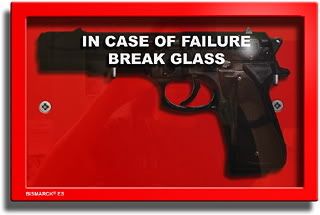
When my husband was young, he joined the cross-country team at his high school. He had never run before, but he was lean, wiry and fast from playing soccer for years. His new team ran around the track for two days, and then went on a four-mile run. Tom was the slowest, having never run a distance like that before. When he got back, he was exhausted, and frustrated. The coach praised those who were fast and had finished first, and did not tell young Tom that with time, practice and technique, he would improve. He did not find anything in what Tom had done that was a success, no matter how small, leaving Tom to feel that he was not talented at this sport, and could never be a success at it. His failure was paramount. His failure defined his future in the sport. Over the course of his life, this singular experience informed the way he felt about himself, how he defined himself.
I think about this when I think about teaching skiing. The power of a coach or a teacher is immense, as is the responsibility. You have in that moment, the chance to change a person’s life forever. To help them redefine themselves, to believe in themselves in a way that they possibly never have before.
When I coach any of the sports that I teach in, I think about this as my first priority. Help the client to see himself or herself in a new light. And more importantly, turn their failures into a tool they can use to make new breakthroughs in their sport.
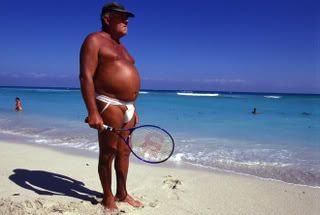
But look at the rest of his game. He is most likely working around every ball, trying to turn each ball into his favorite, point-winning shot. He will run around his backhand and hit a bad forehand. He will, if you are patient, beat himself.
Now this guy, with this unbeatable down the line shot and no other tools in his arsenal can look at a match in two ways. It is a game to be won with his fearsome weapon that he has honed over time, or it is an opportunity to test where he is so he can develop a complete game and be a better player over all.
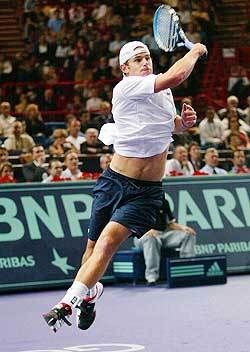
I want to think for a moment about the coach’s ability to infuse the client with a NEW sense of purpose in competition, regardless of their early life experience.
Lets say that we managed to get our hands on Mr. Down The Line. What if we could spend a day with him, and watch him lose his match to an average player with an assortment of average shots and no winning weapon. Mr. Down the Line is down on himself. He has failed. He trained hard, and did not win. His feeling is one of loss, diminished sense of self, and sadness. He probably will go work out the next day and hone that fearsome weapon into something even faster, even closer to the net, even more backspin on it, until it seems unbeatable.
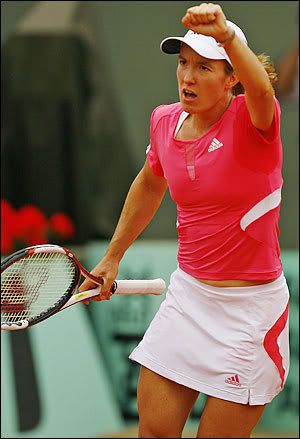
In this way, using “failure” as a diagnostic tool, a client can see that perhaps they can leave their Forehand Down the Line shot for a few weeks, and concentrate instead on the skills that are lacking. I always tell my clients, lets find the thing that you are the WORST at. And then let’s drill it until it is your strength. In this way, you have a list of skills you are constantly eliminating as impediments to success, and turning them into strengths.
Imagine the feeling this client could have suddenly looking at competition as a way to determine his weaknesses, training for three weeks to remove them or turn them into strengths, and looking forward to the next competition to see if he had trained them hard enough, if he needs more work on them, or if he has a new weakness that needs work. Eventually, he will be a total athlete, well rounded, with a toolbag full of skills, some always better than others, PLUS his wicked down the line shot.
If we could get this guy to change his attitude toward competition to view it, and any “failures” within it as diagnostic tools, and to be excited to uncover new weaknesses and change them instead into strengths, over time he will learn to love competition because it is a tool that helps him truly excel at the sport that he loves. You have done this guy a big favor. He doesn’t compete to win anymore, winning is a byproduct of using competition and training wisely. He doesn’t strive for self worth through his medal collection, his worth is defined internally now through his new work ethic, or (even better) his worth is no longer tied to his performance in sports, leaving him emotionally free to try hard, the fear of failure is gone, because failure is something he loves now. Failure is the pointer that shows him what he gets to work on next.
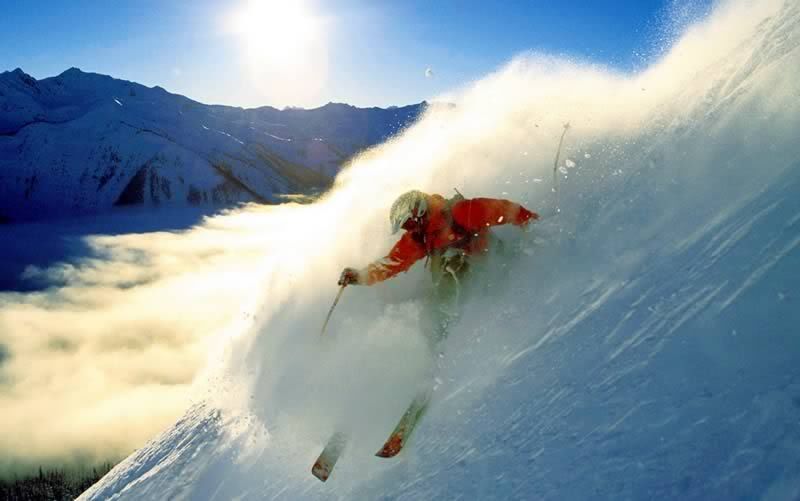
Oh, this is exciting! How formidable would I be as a competitor, how much of a fantastic teacher will I be if I can conquer frozen coral reef? Good lord, can you imagine being able to Josh Foster your way down the steepest, gnarliest, least forgiving frozen fingers of death? Lets make THAT a strength!
How do we do that? Read everything we can get our hands on about skiing in icy conditions (Oh, MAN am I excited about the movement Matrix for this reason!), watch video of people doing it. Try it on frozen groomers. Graduate to frozen crud, that’s not so steep. Get up early before the sun warms it up in the spring and put in the time on the worst stuff you can find. Get frustrated. Reward yourself for skiing in stuff you hate, for challenging yourself to try anyway, by skiing something easy and ego boosting after the sun comes out. Just one or two quickies that make you feel like the king of the world (This would be 10 minutes of practicing that down the line shot in a 90 minute workout). Keep doing it until you suck less.
Then do it until you own it. Then test yourself and realize that you now suck at powder skiing, tree skiing, chutes, steeps, bootpacking, whatever, and make it your strength.
Failure is an athlete’s greatest ally. The way we measure where we are and what skills we need to move forward in our sport without fear. In turning failure from a self-defining, worth breaking harridan into our favorite best friend, we free ourselves from fear of failure. Imagine what you could try if you were not only not AFRAID of failure, but excited about it? And then, imagine the scope of your possibilities for success.
Monday, June 25, 2007
Never Let Go of Your Branch!
This is an excerpt from a book I am writing for my figure skating clients called "Champions in Training". Oddly enough, most of the stuff in this book I learned from years of coaching competitive rock climbers! Take the "Skating" part and trade it for the sport you love, or the job you want to succeed at, and give it a try.
All of us who have participated in a sport we loved have at one time wondered why and how the elite got to be that way. What makes Michelle Kwan so special? How is it that she skated so flawlessly from so young an age? And Tiger Woods? And Andre Aggasi? And Tony Hawk?
Some will say that it is genetics, and a propensity to do well in athletics certainly owes something to being born long lean and fast. But not everyone at the top of his or her game is naturally genetically gifted. In fact, in my experience as a coach it is those with the most natural ability who have the hardest time cracking the top 25%.
Why is that? Aren’t Champions born and not made? Isn’t the Olympic Village peopled with those who started skating before they could walk, were born to parents of Olympic prestige themselves, and who had nothing but the best coaching staff dedicated to their every move their entire lives? Not necessarily! Sometimes yes, but mostly, No.
Who wins, then? Who gets to be a champion? Let’s look.
Imagine this: that the triangle below represents everyone in the world who likes to ice skate.
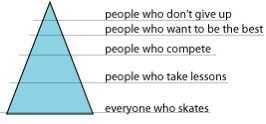
What does it take to make it into the top 5%? Lets start at the bottom of the triangle with everyone. First, you have to like to skate. Then, you’ll probably take some lessons. If you do well and still enjoy it you might start competing. If you like competing, you probably want to win. Lets be honest, even if you DON’T like competing (and you’d be surprised how many people don’t) you probably still like the idea of being a famous well loved awesome ice skater who goes to the Olympics.
Making it from the group of people who compete (the top 50% of people who skate) into the group who does well enough to start training, who have Olympic dreams, who have desire to be the best is right around where I come in.
Stepping into the top30%, joining the group of “contenders”, or people who we can seriously consider as contenders takes something special. Most of us can guess what those things are, but let’s list them so that we know that it is hard work and not magic that gets us there.
• A love of skating
• Understanding that it takes work to improve
• A desire to improve
Lets stop right there. If I love to skate. And I understand that it takes work to get better, and I have a desire to get better, then… You have to learn to love to work!
• A love of the work that will make you better
• Determination to keep working when it gets hard
Have you noticed that I haven’t yet said “A will to win?” That’s because it takes a LOT more than a desire to win to become a champion. If I had to put “Will or Desire to Win” on the triangle above, I would have to put it down at the bottom with “Takes Skating Lessons”!
• Surround yourself with people who want you to succeed
• Get a coach you trust and listen to them
This list will get you into a more elite group. The big question is… how do you get out of this group and into success? The first guess is that the people who rise to the top of this group are naturally gifted.
Let me assure you that is not the case. I have trained people with more natural talent than anyone would know what to do with. I have trained people who had to work a hundred times harder to land a jump that came in a week to a peer. Its true that you need to have an ability to skate, and enough intuition and natural athleticism to master the moves, but what makes a champion?
Lets look at another triangle for the answer:
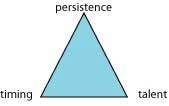
Here is my golden rule. It takes any combination of two of the above to succeed. That means: Timing (being in the right place at the right time, or more accurately, putting yourself in the right place at the right time) and Persistence are as likely to succeed as Timing and Talent, or Talent and Persistence. Talent alone won’t get you there. Being in the right place at the right time won’t get you there alone.
The top five percent are people who have remembered that, and are smart enough to hang their hat on persistence, keeping talent and timing in mind.
Imagine that all the competitors in the top 30% (All of whom are good enough to qualify for Senior Nationals. They all have triples. They all have put in the time, they all have spent a lot of money and made a lot of sacrifices.) are in a tree, hanging on to branches.
Let’s imagine that to make it to the top 5%, to be a real champion, all you have to do is hang on to your branch when the tree gets shaken.
What shakes the tree?
• Injury
• Failure
• Depression
• Loss of belief in yourself
You have been skating all your life. You and your family have made sacrifices. The last three competitions you have placed in the bottom 5 in the field. You examine your choices and… give up? Or hang on to your branch? What can you do here? Give up and never make the top five, or…
• Talk to your coach
• Make a new strategy
• Go back to basics
• Learn to reinvent yourself
• Hang on
And crack the top 5%. In my experience, everyone in the top 30% is talented to some degree. Everyone has an almost equal chance of becoming a champion, belonging to the top 5. The difference between the groups?
The only difference is that the people in the top 5% didn’t let go of their branch. They have a cantankerous desire to improve that makes them hang on, back up, and find another maze.
Want to be in the top 5? Never let go of your branch.
All of us who have participated in a sport we loved have at one time wondered why and how the elite got to be that way. What makes Michelle Kwan so special? How is it that she skated so flawlessly from so young an age? And Tiger Woods? And Andre Aggasi? And Tony Hawk?
Some will say that it is genetics, and a propensity to do well in athletics certainly owes something to being born long lean and fast. But not everyone at the top of his or her game is naturally genetically gifted. In fact, in my experience as a coach it is those with the most natural ability who have the hardest time cracking the top 25%.
Why is that? Aren’t Champions born and not made? Isn’t the Olympic Village peopled with those who started skating before they could walk, were born to parents of Olympic prestige themselves, and who had nothing but the best coaching staff dedicated to their every move their entire lives? Not necessarily! Sometimes yes, but mostly, No.
Who wins, then? Who gets to be a champion? Let’s look.
Imagine this: that the triangle below represents everyone in the world who likes to ice skate.
What does it take to make it into the top 5%? Lets start at the bottom of the triangle with everyone. First, you have to like to skate. Then, you’ll probably take some lessons. If you do well and still enjoy it you might start competing. If you like competing, you probably want to win. Lets be honest, even if you DON’T like competing (and you’d be surprised how many people don’t) you probably still like the idea of being a famous well loved awesome ice skater who goes to the Olympics.
Making it from the group of people who compete (the top 50% of people who skate) into the group who does well enough to start training, who have Olympic dreams, who have desire to be the best is right around where I come in.
Stepping into the top30%, joining the group of “contenders”, or people who we can seriously consider as contenders takes something special. Most of us can guess what those things are, but let’s list them so that we know that it is hard work and not magic that gets us there.
• A love of skating
• Understanding that it takes work to improve
• A desire to improve
Lets stop right there. If I love to skate. And I understand that it takes work to get better, and I have a desire to get better, then… You have to learn to love to work!
• A love of the work that will make you better
• Determination to keep working when it gets hard
Have you noticed that I haven’t yet said “A will to win?” That’s because it takes a LOT more than a desire to win to become a champion. If I had to put “Will or Desire to Win” on the triangle above, I would have to put it down at the bottom with “Takes Skating Lessons”!
• Surround yourself with people who want you to succeed
• Get a coach you trust and listen to them
This list will get you into a more elite group. The big question is… how do you get out of this group and into success? The first guess is that the people who rise to the top of this group are naturally gifted.
Let me assure you that is not the case. I have trained people with more natural talent than anyone would know what to do with. I have trained people who had to work a hundred times harder to land a jump that came in a week to a peer. Its true that you need to have an ability to skate, and enough intuition and natural athleticism to master the moves, but what makes a champion?
Lets look at another triangle for the answer:
Here is my golden rule. It takes any combination of two of the above to succeed. That means: Timing (being in the right place at the right time, or more accurately, putting yourself in the right place at the right time) and Persistence are as likely to succeed as Timing and Talent, or Talent and Persistence. Talent alone won’t get you there. Being in the right place at the right time won’t get you there alone.
The top five percent are people who have remembered that, and are smart enough to hang their hat on persistence, keeping talent and timing in mind.
Imagine that all the competitors in the top 30% (All of whom are good enough to qualify for Senior Nationals. They all have triples. They all have put in the time, they all have spent a lot of money and made a lot of sacrifices.) are in a tree, hanging on to branches.
Let’s imagine that to make it to the top 5%, to be a real champion, all you have to do is hang on to your branch when the tree gets shaken.
What shakes the tree?
• Injury
• Failure
• Depression
• Loss of belief in yourself
You have been skating all your life. You and your family have made sacrifices. The last three competitions you have placed in the bottom 5 in the field. You examine your choices and… give up? Or hang on to your branch? What can you do here? Give up and never make the top five, or…
• Talk to your coach
• Make a new strategy
• Go back to basics
• Learn to reinvent yourself
• Hang on
And crack the top 5%. In my experience, everyone in the top 30% is talented to some degree. Everyone has an almost equal chance of becoming a champion, belonging to the top 5. The difference between the groups?
The only difference is that the people in the top 5% didn’t let go of their branch. They have a cantankerous desire to improve that makes them hang on, back up, and find another maze.
Want to be in the top 5? Never let go of your branch.
Subscribe to:
Posts (Atom)